

Delivery Strategy
How Local Shops Compete With Amazon on Delivery
You will not out-warehouse Amazon. Same-day local delivery is the one part of the comparison where a shop three miles away holds the advantage.
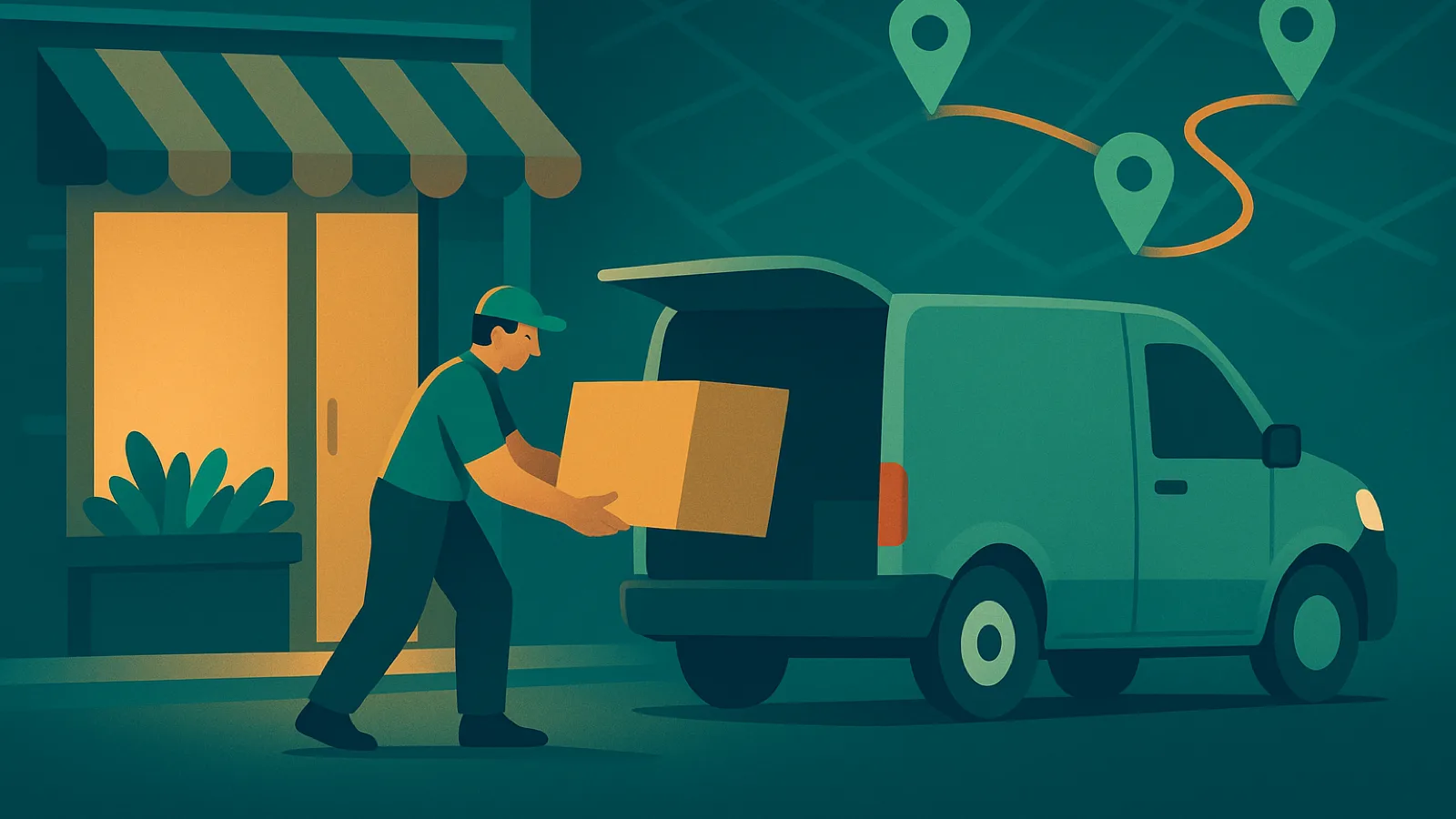
A customer stands in your store holding something heavy, doing the arithmetic on whether to carry it to the car now or tap a button and have the same item appear at home tomorrow. Personal service does not settle that question. Logistics does.
There is one part of that comparison where you hold the structural advantage, and most independent retailers never use it.
Give Amazon its due first
Amazon's advantage is fulfillment infrastructure: warehouses positioned near population centers, inventory placed before anyone orders it, and a delivery network sized to absorb enormous volume at low marginal cost. It is a genuinely impressive operation, and you will not replicate any part of it.
What that infrastructure buys is predictability at almost any distance. A customer knows roughly when the box lands, from anywhere, for nearly anything.
Speed over the last three miles works differently. Amazon's fastest option still involves a warehouse, a sortation step, and a route. Your inventory already sits in the building the customer is standing in, or three miles from their house. Amazon can get it there tomorrow. You can get it there this afternoon.
The advantage only counts once customers know
This is where local retailers lose a race they were winning.
The shop can absolutely get a sofa across town today. The customer never finds out, because nothing on the website says so, no delivery option appears at checkout, and the only way to discover it is to ask somebody.
Amazon's delivery promise sits right next to the buy button, visible before the customer commits. Yours often surfaces after the sale, if at all. An unadvertised capability does not compete with an advertised one.
So the first move is not operational. Put the delivery option and the cutoff time where customers see them: on product pages, at checkout, on the storefront window, in the confirmation email.
What a credible promise needs
"We deliver" invites follow-up questions, which is friction. A promise a customer can act on has four parts.
It needs a stated cutoff, and "order by 2 PM for delivery today" is the single highest-value thing you can publish. It converts a vague maybe into an instant decision, and it protects you, because an order at 4:45 becomes tomorrow's job by policy rather than by argument. It needs a clear area, so nobody has to guess whether they qualify. It needs visible tracking, since what makes two-day shipping feel reliable is that the customer can watch the package the whole way. A local delivery with no visibility feels less certain than a national one with a tracking page, even when it arrives sooner. And it needs a cost stated up front, because the same fee revealed at the final checkout step reads as a penalty and shown early reads as a service.
None of that requires infrastructure. It requires deciding your policy and publishing it.
Where local delivery wins outright
Four situations favor a shop three miles away over a warehouse three states away.
When today matters, tomorrow is a different product entirely. A birthday tonight, a repair that cannot wait, a replacement needed before a client arrives.
When the item is large or awkward, freight shipping gets slow and expensive while a van from across town stays neither. Furniture, appliances, big framed pieces: oversize delivery covers ground that national shipping genuinely struggles with.
When the item is fragile or perishable, nothing should spend a night in a sortation facility.
And when the customer wants to buy from you specifically, plenty of people would rather support a local shop. They will not do it at the cost of a week of waiting. They will absolutely do it when the wait is a few hours.
Those are your high-margin orders. Large items, time-critical purchases, considered buys. Delivery protects exactly the sales worth protecting.
What it costs
The instinct is that delivery erodes an already-thin margin, and that depends entirely on how you pay for it.
A commission model takes a percentage of every order, so the fee grows with order value while the work stays identical. Delivering a six-hundred-dollar dining chair is the same drive as delivering a sixty-dollar one. Paying ten times as much for it turns your best orders into your worst-margin orders.
Per-delivery pricing charges for the trip instead of the receipt, with a base fee plus a per-mile rate. For a shop whose advantage lies in large and considered purchases, that difference is the entire economics of offering delivery. See how pricing works for the structure.
You also do not need to hire anyone. Payroll turns delivery into a fixed cost, which is the wrong shape while you are still learning your volume.
Start with one category
Do not launch delivery across the whole catalog. Pick the category where your advantage is sharpest, usually the large items or the time-critical ones, and offer it there first.
Publish a cutoff. Set a radius you can comfortably serve. Run it for a month. You will learn what customers actually want delivered, what your true average distance is, and whether your packaging survives a car. Then widen it.
Amazon spent twenty years and an enormous amount of money to reach a customer's door tomorrow. You are already three miles away, and that advantage starts counting the moment you tell people it exists.
Common Questions
Can a small shop compete with Amazon on delivery?
On local speed, yes. Your inventory already sits near the customer, so same-day is achievable where a warehouse network needs a day. Price, selection, and national coverage remain Amazon's. The local advantage only counts if you advertise it before the customer buys.
Do I need to offer free delivery to compete?
No. Customers accept a stated delivery fee when it appears early and the service is fast. What damages conversion is a surprise charge at the final checkout step. Show the cost and the cutoff time up front and it reads as a service.
What is the lowest-risk way to start offering delivery?
Use a per-delivery service rather than hiring. There are no contracts, no minimums, and no vehicle or payroll costs, so you pay only when you actually deliver. Start with one product category and a tight radius to learn your real volume first.
Which orders should I prioritize for local delivery?
Large items, fragile or perishable goods, and anything time-critical. National shipping is slowest and most expensive on exactly those, so your proximity is worth the most there. They also tend to be higher-margin orders.
The gap between "we could deliver that" and "we deliver, order by 2 PM" is where the sales are. Get a quote to size it against your order volume.
Need delivery you can count on?
UniHop handles last-mile delivery for local businesses — no contracts, no commissions.
Talk to Sales