

Operations
What Actually Happens When a Catering Delivery Fails
Most catering delivery failures are visible twenty minutes before the client notices. What happens inside that window decides whether you keep the account.
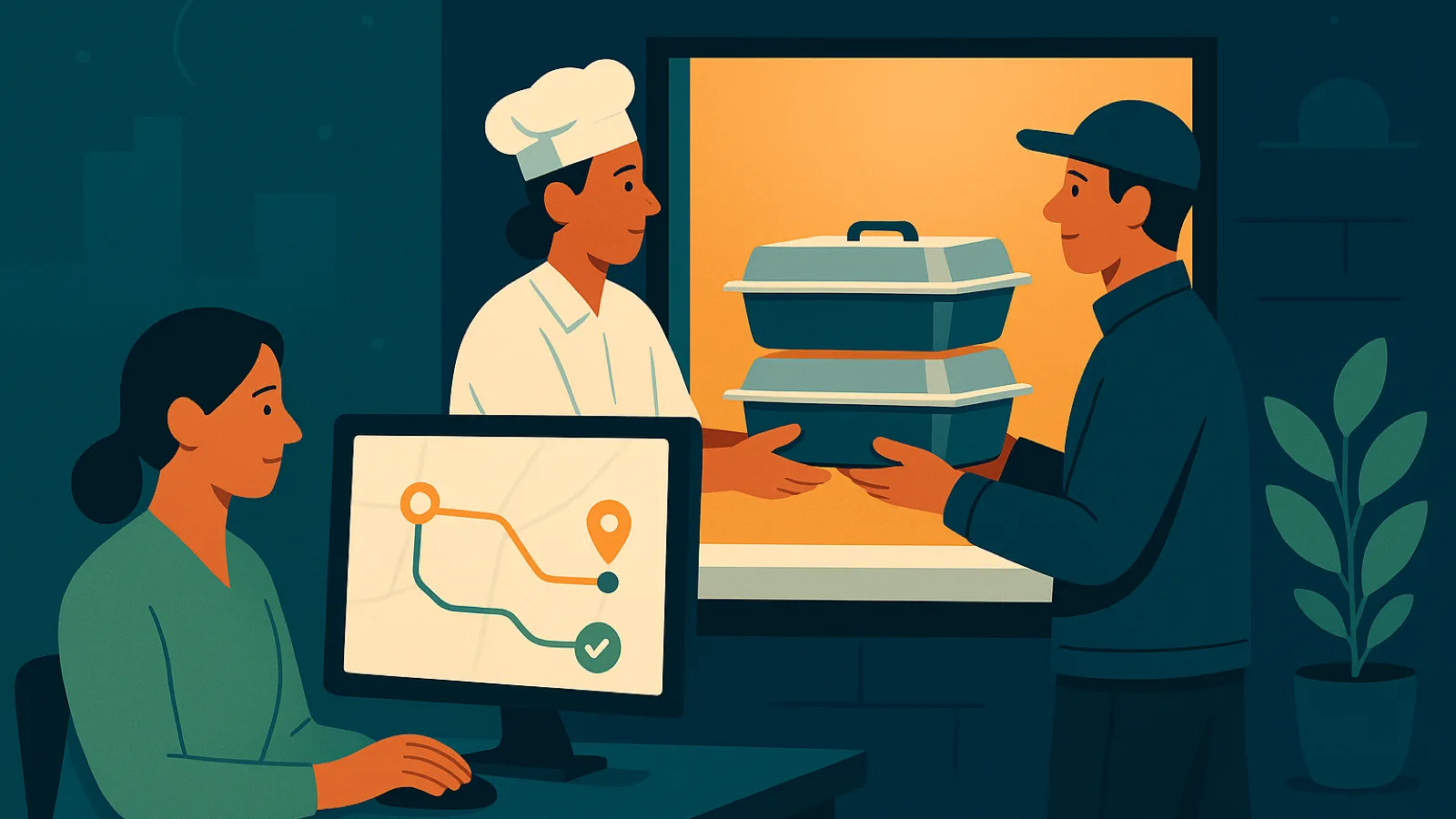
An order for a twelve o'clock board lunch drops into your system the night before. Everything on your side runs clean: the trays are built, labeled, and staged by eleven. At 12:15 the client calls to ask where the food is, and the answer is that you have no idea.
Every catering operation has failures. The useful question is what happens between the moment a delivery starts going wrong and the moment your client finds out. That gap usually runs fifteen to thirty minutes, and almost everything that matters happens inside it.
Catering deliveries fail in a small number of ways
After enough volume the failure modes stop being surprising. Nearly all of them fall into five buckets.
Sometimes nobody picks the order up. No driver accepts it, or one accepts and then drops it. This clusters around peak lunch hours and larger vehicle requirements, and it is the most recoverable failure of the five, because it happens before anything has physically moved.
Sometimes a driver arrives and cannot complete the pickup. The order is not staged yet, the loading entrance is different from the address on file, or six full trays will not fit in the sedan that showed up. Most of these trace back to information that was wrong or missing when the order was placed, which makes them preventable rather than recoverable.
Sometimes something goes wrong in transit. A breakdown, an accident, a driver who stops responding. Rare, and when it happens your food is stranded somewhere between your kitchen and a room full of people expecting lunch.
Sometimes the order reaches the wrong place. Left at the main reception desk of a building where the meeting is on the fourth floor, or handed to someone who signs for it and puts it down somewhere. This one is dangerous because it looks like a success in the system. The delivery is marked complete, and nobody knows otherwise until the client says so.
And sometimes the food arrives late enough to matter. Technically delivered, functionally a failure, because a board lunch at 12:15 for a twelve o'clock meeting has already gone wrong.
Each of those has a different window for intervention. Two can be caught before the client is affected. Two can only be caught if somebody is actively watching. One usually surfaces when the client reports it.
The twenty minutes that decide the outcome
Here is where delivery services actually differ from each other, and it has very little to do with the drivers.
A driver accepts your pickup and then does not move for fifteen minutes. Nothing has failed. The system shows an active delivery. The client's tracking link shows an active delivery. Every dashboard is green.
With nobody looking at that, the next event is your client calling you.
With somebody looking at it, the next event is a phone call to the driver. Usually it turns out to be something ordinary, like a driver parked and waiting on a staging area or stuck in a garage with no signal, and the delivery continues with nobody the wiser. Occasionally it is not ordinary, and the order gets reassigned before the delay compounds into a missed meeting.
That is the whole difference, and it comes down to having somebody whose job is to notice the delivery that stopped moving.
What recovery looks like
When a call to the driver cannot fix the situation, the next step is sending a replacement driver to collect the order and finish the run. At UniHop that carries no additional charge to you, and it applies to every delivery style including Standard.
Two caveats, because the detail matters more than the headline.
These are judgment calls rather than automatic triggers. A driver who is quiet for ten minutes does not get replaced on a timer. It depends on where the food is, how tight the window is, and what the driver's history looks like. A breakdown or an order taken to the wrong building almost certainly does warrant one. The dispatch team makes that call from the circumstances.
The second caveat is that some problems are invisible until they are reported. An order left at the wrong desk registers as a completed delivery, so there is no signal to react to. In those cases the sequence runs differently: the client reports it, UniHop investigates, and a refund follows when that is the right outcome. Any provider claiming they always know before you do is describing something that cannot be true.
Human dispatch monitoring runs from 5 AM to midnight, seven days a week. Orders are accepted and deliveries run 24/7/365, with automated systems handling fulfillment overnight.
Compensation and recovery are different products
This is where marketplace platforms and managed services genuinely diverge, and it is worth understanding before you need it.
On a marketplace platform, a delivery problem produces a ticket. The ticket gets handled after the fact, by somebody who was not watching, often after the outcome is already fixed. The resolution is usually a credit. A credit does not put lunch in front of a board meeting.
With a managed service, the problem produces a phone call to a driver while the delivery is still moving. The resolution is the food actually arriving.
For a fifteen-dollar order, a credit is a fine outcome. For a four-hundred-dollar catering order attached to a corporate account you spent two years earning, the two are not remotely equivalent. One failed event is the thing that ends those accounts.
What to ask before you commit
Five questions surface the difference quickly. Is anyone monitoring deliveries in progress, and during which hours? What happens when a driver stops responding mid-run? Who pays when a replacement driver is needed? Does any of this apply to the lowest-cost service level, or only the premium one? And what does the refund process look like when something cannot be fixed?
A provider with good answers gives you specifics. A provider without them talks about their technology.
Common Questions
What happens if something goes wrong with my delivery?
The dispatch team monitors every delivery and contacts the driver directly if something seems off. Most issues get resolved with a quick check-in. For situations that need more, UniHop can dispatch a replacement driver at no additional cost, and provides refunds when something cannot be made right.
Does UniHop charge extra to send a replacement driver?
No. When a situation calls for a replacement driver, there is no additional charge to you, and it applies to all delivery styles including Standard. Whether a replacement gets sent is a judgment call the dispatch team makes from the circumstances.
Are catering deliveries monitored around the clock?
Orders are accepted and deliveries are available 24/7/365. Human dispatch monitoring runs from 5 AM to midnight, seven days a week, with automated systems supporting orders overnight. Tracking, status updates, and photo confirmation apply to every delivery regardless of hour.
Which delivery style should catering orders use?
Special Handling assigns a dedicated driver from pickup through delivery, with basic placement at the destination. Standard routes through courier networks and suits routine, lower-stakes orders. Matching the style to the stakes keeps costs sensible without risking your high-value events.
When you are comparing providers, press hardest on the monitoring question, because that is where the real differences hide. Get a quote and ask what happens on your next twelve o'clock drop.
Need delivery you can count on?
UniHop handles last-mile delivery for local businesses — no contracts, no commissions.
Talk to Sales